in <b>/var/www/vhosts/eppleycustomfacialimplants.rosemontmediaweb.com/httpdocs/wp-content/themes/Skullreshaping/inc/home-slider.php</b> on line <b>47</b><br />
https://eppleycustomfacialimplants.rosemontmediaweb.com/wp-content/uploads/2021/07/Eppley_Custom_Facial_Implants_Logo.png)
Patient-Specific Facial Implants

The idea of what defines a ‘custom’ facial implant has evolved dramatically over the last decade. In the past, custom implants were often improvised in the operating room. Surgeons would shape standard implants or raw implant materials by hand, guided by their artistic judgment and external observation of the patient’s face. Like sculptors, they relied on experience, intuition, and aesthetic sensibility to carve and position what they hoped would be an ideal fit.

While this required a skilled eye and steady hand, today’s approach is far more precise, collaborative, and technologically advanced—ensuring outcomes that are not just refined but meticulously customized to the patient’s unique anatomy.

While the idea of a surgeon hand-sculpting a facial implant in the operating room may sound romantic, this approach comes with real limitations. Relying solely on visual estimation and artistic instinct often overlooks the complex nuances of each patient’s anatomy—leading to unpredictable aesthetic results.
Today, advanced imaging and design technology have removed much of that guesswork. With ultra-high-resolution 3D CT scans—sliced at 1.0mm or less—surgeons can generate detailed, three-dimensional models of a patient’s facial structure. This unprecedented level of anatomical insight, combined with sophisticated computer-aided design software, allows for the creation of truly precise, patient-specific implants.
The result? Dramatically improved outcomes, more predictable results, and a level of customization that once seemed impossible. In fact, with the exception of tissue limitations, nearly anything a patient and surgeon can envision is now possible to design and bring to life surgically.
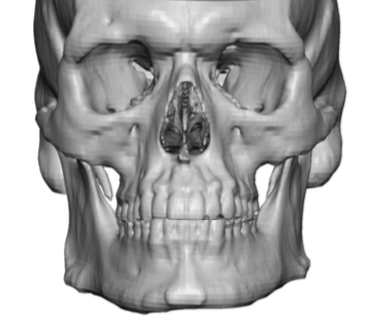
The custom implant process starts with a 3D CT scan of the patient’s face, typically performed at an imaging center near the patient’s home or work. For procedures focused on the chin, jaw angles, or full jawline, a cone beam CT (CBCT) scan—often available at dental offices—may be sufficient.
Once the scan is received, Dr. Eppley creates an initial implant design. This design is guided by a visual assessment of the patient’s aesthetic goals, which have been established through prior photographic and video analysis. These reference images help define the ideal implant dimensions and provide the framework .to sculpt a bespoke design that reflects the patient’s vision with Dr. Eppley’s anatomical precision and expertise.
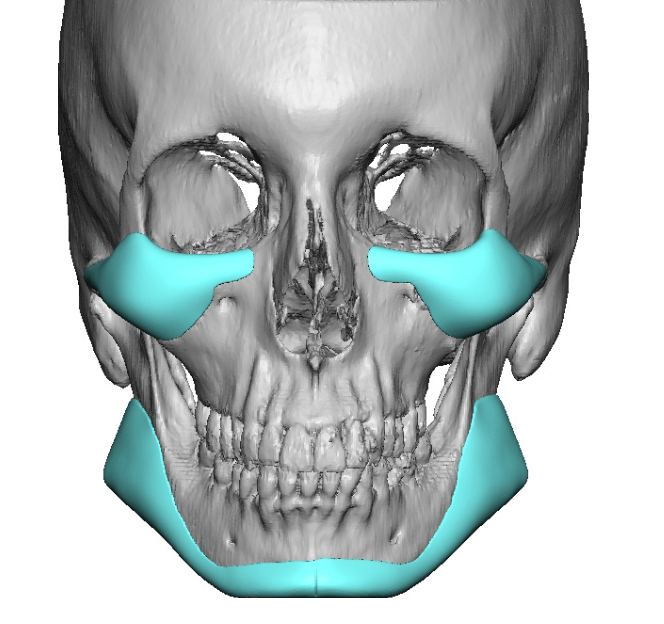
The first set of implant design images are sent to the patient, and a virtual (on in-person) discussion about the design is scheduled. Based on this conversation, a final implant design is created by Dr. Eppley, and the creation process begins. Having designed and surgically placed thousands of custom implants, Dr. Eppley makes the final determination about what design is ideal for the patient’s goal, keeping safety and the ideal outcome foremost in mind.

One frequent misunderstanding of the custom implant design process is that it is not an exact science. While making the implant and determining its dimensions is an exact science, knowing what the exact aesthetic outcome will be is not. There is no technology yet available that allows one to know for sure the aesthetic outcomes of any custom implant design. It is not yet possible to take an implant design, put the soft tissue back over it and then see what it looks like. This would be great if it existed and would make the design process much easier but it is simply not yet available. For now it takes an experienced surgeon to translate the computer imaging into an implant design that can come close to the patient’s desired facial augmentative result.
There are several critical time components to the custom facial implant process. Once the process is initiated the minimal length of time until the implant(s) are available for surgery is eight (8) to ten (10) weeks. If a surgery date has been established at the start of the design process, the implant design must be completed thirty (30) days before the surgery date to allow for adequate manufacture, sterilization and shipping time to arrive for the surgery.